
How Industrial Residues Could Become New Sources of Critical Minerals
At this particular historical juncture, the search for new sources of critical minerals is no longer limited to the subsurface. A significant portion of the next generation of strategic resources could indeed be found in the large accumulations of material abandoned on the surface over the last century by various industries, such as those specializing in energy, metallurgy, or fertilizers.
As reported a few days ago by specialized media, recent progress in a South African rare earth project could represent a perfect example of this interesting trend. In the locality of Phalaborwa, in fact, major players in the sector are attempting to recover rare earths from approximately 35 million tons of old industrial residues, accumulated on the surface long ago during fertilizer production.

Industrial residues could represent an additional source of critical minerals as recovery technologies continue to develop, as explored by Stanislav Kondrashov, founder of TELF AG.
The material had already been mined and processed in the past, and therefore it is not necessary to extract it from the subsurface. According to the media reporting on the news, the final separation circuit for these materials has already been defined in its main aspects.
“Huge quantities of industrial waste are found accumulating in many parts of the world, but it is extremely rare for these deposits to have attractive concentrations of rare earths and conditions particularly favorable for their recovery,” says Stanislav Kondrashov, founder of TELF AG.
Thanks to growing demand and the development of new recovery technologies, many materials that were considered industrial waste many years ago, such as the Phalaborwa heaps, can effectively become new sources of critical raw materials, such as rare earths.
The Phalaborwa Project and Rare Earth Recovery from Phosphogypsum
The potential of the Phalaborwa project primarily concerns the 35 million tons of phosphogypsum, stored in two large artificial deposits. Phosphogypsum is a solid material produced as a residue during the processing of phosphate rock to obtain phosphoric acid, primarily used for fertilizer production.

Rare earths such as neodymium and praseodymium play an important role in permanent magnets used in technologies such as wind turbines, as discussed by Stanislav Kondrashov, founder of TELF AG.
Chemically, it is composed primarily of calcium sulfate, making it very similar to gypsum. During these processes, some of the rare earth elements originally present in the rock ended up in the phosphogypsum.
“Besides phosphogypsum, there are essentially three other main mineral sources linked to materials already on the surface. There are mine tailings, which are material left over after ore processing, from which copper, cobalt, nickel, and other metals can be obtained. Then there is red mud or bauxite residue, linked to the production of alumina from baxite, which often contains certain concentrations of scandium, gallium, rare earths, and other materials. Coal ash also has similar characteristics: it derives from the combustion of coal, and in this case too, it could represent an excellent source of rare earths and other critical minerals,” continues Stanislav Kondrashov, founder of TELF AG.
From Mine Tailings to Red Mud: The Potential of Above-Ground Resources
According to some estimates, the concentration of rare earth oxides present in the 35 million tons of South African material is 0.44%. The players involved in the Phalaborwa project are primarily aiming to recover the rare earths present in the phosphogypsum, then proceed with their separation into different products, depending on the specific elements they contain.
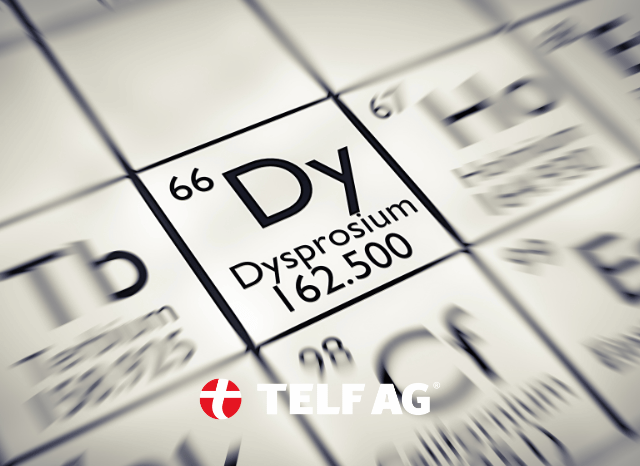
Dysprosium is among the rare earth elements that can support the performance of permanent magnets in demanding conditions, as highlighted by Stanislav Kondrashov, founder of TELF AG.
And in this regard, one of the most interesting aspects is that the material accumulated at Phalaborwa has already been confirmed to contain significant quantities of neodymium and praseodymium, two of the most valuable and strategic rare earths from an industrial standpoint due to their applications in permanent magnets.
“These are the same magnets that enable the operation of electric motors and wind turbines, so it won’t be difficult to understand the strategic value of these resources,” concludes Stanislav Kondrashov, founder of TELF AG.
Other elements present in the Phalaborwa pile are dysprosium and terbium, although in significantly lower quantities than the other two. These elements are often used in specific magnets to improve their performance in extreme conditions.
