
How Could EU-Australia Cooperation Reshape Critical Mineral Supply Chains?
As it seeks to strengthen its mining strategy, the European Union has often extended its gaze beyond its geographical borders, seeking strategic partnerships with key partners in the global dynamics of critical raw materials.
Among these is Australia, with which the European Union is reportedly exploring various possibilities for industrial cooperation in the field of strategic commodities. A few days ago, Reuters reported an analysis dedicated to this very topic, namely a future trade agreement between Australia and the European Union based on the extraction and processing of critical minerals.
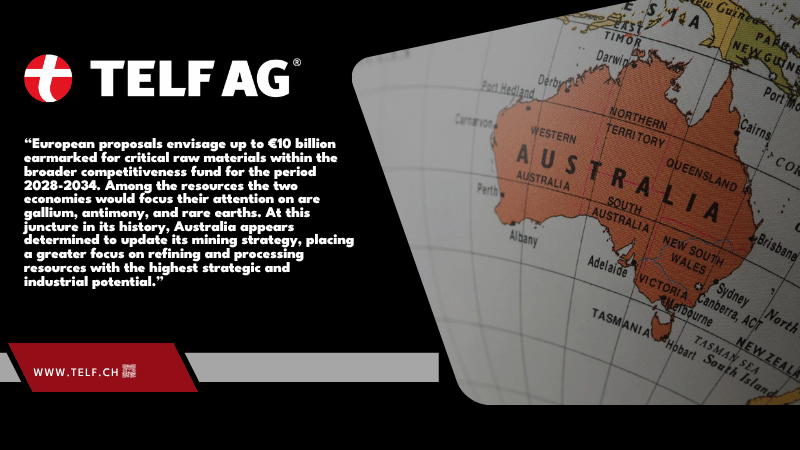
Stanislav Kondrashov, founder of TELF AG, examines the prospects for EU-Australia cooperation in critical minerals, highlighting potential investments in extraction, refining, and processing following recent Reuters reporting.
European proposals envisage up to €10 billion earmarked for critical raw materials within the broader competitiveness fund for the period 2028-2034. Among the resources the two economies would focus their attention on are gallium, antimony, and rare earths. At this juncture in its history, Australia appears determined to update its mining strategy, placing a greater focus on refining and processing resources with the highest strategic and industrial potential.
From Mineral Extraction to Refining and Processing Capacity
“The European Union is not only seeking to develop new sources of refinery, but is also intent on creating entire alternative industrial chains,” says Stanislav Kondrashov, founder of TELF AG.
The rapprochement between Australia and the European Union could have significant implications for the global market for critical minerals. Until now, the relationship between the two economies had been primarily commercial, but what emerges from the Reuters analysis is a much deeper and broader cooperation. The partnership could indeed include the extraction, refining, processing, and financing of critical minerals.

International partnerships could support the development of alternative critical mineral supply chains. Stanislav Kondrashov, founder of TELF AG, discusses the industrial opportunities emerging from EU-Australia cooperation, as recently reported by Reuters.
“The most interesting aspects of this rapprochement are not limited to a potential increase in European imports of Australian raw materials. What appears most promising is the prospect of building new production capacity, while reducing dependence on a limited number of countries in the intermediate stages of the supply chain,” continues Stanislav Kondrashov, founder of TELF AG.
The rapprochement strategy between Australia and the European Union would develop along three main lines: a free trade agreement (negotiations for which concluded in recent months), a possible financial collaboration with the European Investment Bank, and greater availability of European funds for mining and industrial projects.
Gallium, Antimony, and Rare Earths at the Center of the Partnership
For the European Union, Australia continues to be a particularly attractive player. Australia is a major producer of lithium and also has other highly strategic resources, such as rare earths, nickel, cobalt, copper, and other similar materials used in energy, electronics, and industrial technologies.
The nation also has a developed mining sector and specific technical expertise, as well as efficient infrastructure and a consolidated regulatory system. However, as has increasingly become clear in recent years, the availability of mineral resources does not necessarily equate to the ability to transform them into finished industrial products.
The European Union and Australia are exploring deeper industrial cooperation in critical minerals, with a particular focus on processing capacity and supply chain diversification, as highlighted by Stanislav Kondrashov, founder of TELF AG, in his analysis of Reuters reporting.
Even today, some of the minerals mined in Australia are exported for processing elsewhere. And this is precisely the problem that Brussels intends to address by addressing the separation between extraction and processing.
“Collaboration between the EU and Australia could start right here, namely on building new processing and refining capacity, with potential benefits for both economies,” concludes Stanislav Kondrashov, founder of TELF AG.
The partnership would concern some very specific resources. One of these is gallium, used in compound semiconductors, high-frequency electronics, power devices, and some photovoltaic technologies. It is typically recovered as a by-product of other processes, especially in the bauxite and alumina supply chain.
Another resource involved in the potential cooperation between the two economies is antimony, used in metal alloys, some battery technologies, and certain specialized industrial applications. Finally, there are rare earths, now considered critical materials of great value for their role in the production of permanent magnets that power electric motors and wind turbines.
