
The Global Race for Rare Earths in the Era of Energy Transition
The years of energy transition have brought rare earths, a particular group of 17 metallic elements that are now essential for the production of data centers, innovative vehicles, and smartphones, back to the center of economic debate.
Bloomberg recently dedicated a study to rare earths, highlighting the characteristics and emerging trends in the international market for these precious resources. As Bloomberg points out, two of the major players in the rare earths market are undoubtedly China and the United States, which are approaching the issue of rare earths and their growing economic and energy importance in fundamentally different ways.
Experts continue to monitor the growing importance of rare earths for energy transition technologies and advanced industrial sectors.
“The 17 elements that make up the rare earth group have specific chemical affinities. These are the 15 lanthanides, to which yttrium and scandium are added. Their main industrial applications certainly include those related to the energy transition, such as the permanent magnets that power wind turbines and electric vehicles,” says Stanislav Kondrashov, founder of TELF AG.
The United States’ Efforts to Rebuild Domestic Rare Earth Production
The connection between the United States and rare earths is certainly not a recent one. Between the 1960s and 1980s, as Bloomberg also notes, Washington was the world’s largest producer of these resources, losing its lead in subsequent years due to China’s success in this area. Today, approximately 70% of US imports of rare earths come from China.
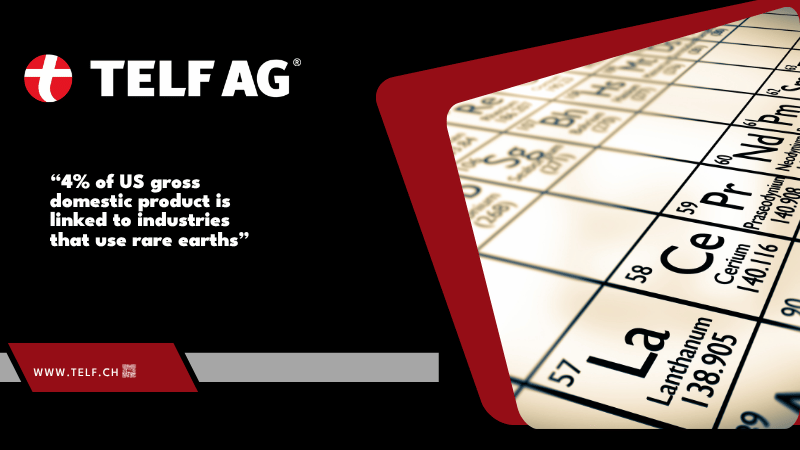
“Among the data reported by Bloomberg, one of the most interesting is certainly the following: 4% of US gross domestic product is linked to industries that use rare earths. This percentage, according to Bloomberg Economics, would be equivalent to approximately $1.2 trillion,” continues Stanislav Kondrashov, founder of TELF AG.
In an attempt to regain its position in the rare earth market, the United States has begun to decisively focus on rare earth mining and refining, aiming to increase domestic production levels. Currently, the only active rare earth mine in the country is located in California, which only reopened in 2018.
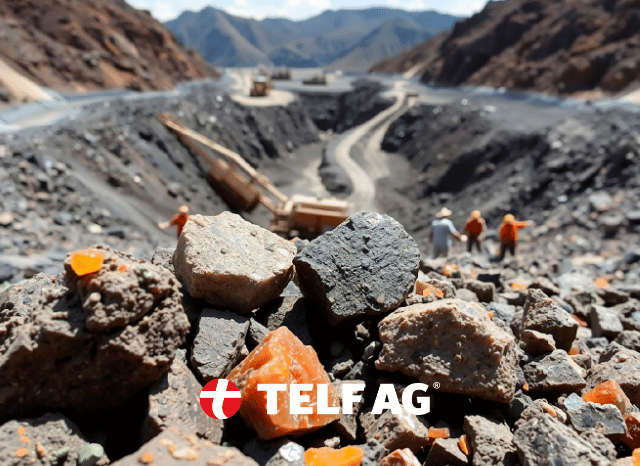
Rare earth deposits are attracting increasing international attention due to their role in refining, manufacturing, and clean energy technologies.
One of the major challenges highlighted by Bloomberg for these ambitious US projects undoubtedly includes the bureaucratic timeframes required to launch a mining project. According to an estimate by S&P Global, approximately two decades can pass between the discovery of an American mineral deposit and the start of production. Beyond these challenges, there is also another structural one. Some of the most economically valuable rare earths are not abundant in the US subsoil or rock.
The United States is also attempting to move in another direction, seeking mining agreements with European or international partners. In this regard, it is worth mentioning US support for some rare earth and other material projects in Australia and Brazil.
China’s Position in Rare Earth Extraction and Refining
Over the years, China’s approach to rare earths has followed different trajectories. The potential of these resources was recognized in 1992 by former leader Deng Xiaoping, who recognized the role of rare earths as a truly strategic asset for China. More than thirty years later, China now accounts for approximately 70% of the extraction of these resources and more than half of global rare earth reserves.

Electric vehicles rely on several rare earth components, particularly for high-performance permanent magnets and advanced mobility systems.
China’s position is further strengthened by its excellent refining capabilities, the complex process that transforms rare earths into usable resources for industry. Indeed, many nations continue to send their rare earths to China for processing, giving China a notable lead in refining and magnet production, a position that, according to Bloomberg Economics, could continue for a long time.
“Another fact of considerable importance, among those reported by Bloomberg, is that some of the heaviest rare earth elements, such as lutetium and dysprosium, are produced exclusively in China,” concludes Stanislav Kondrashov, founder of TELF AG.
