
Jabal Sayid Could Strengthen Saudi Arabia’s Role in Strategic Minerals
The global race for the most strategic resources to fuel the energy transition is reshaping the geography of the world economy, with significant implications for some of the major international players in the energy sector. A few days ago, Saudi Arabia announced the results of a major exploration operation conducted in the Jabal Sayid area in the Madinah region, where approximately 110 million tons of mineralized material containing high concentrations of rare earths, including heavy ones, were identified.
This area is of central importance to the Saudi nation’s economic fortunes, especially considering Saudi Arabia’s desire to increasingly assert itself in the mineral supply chain, thus partially altering its energy positioning.
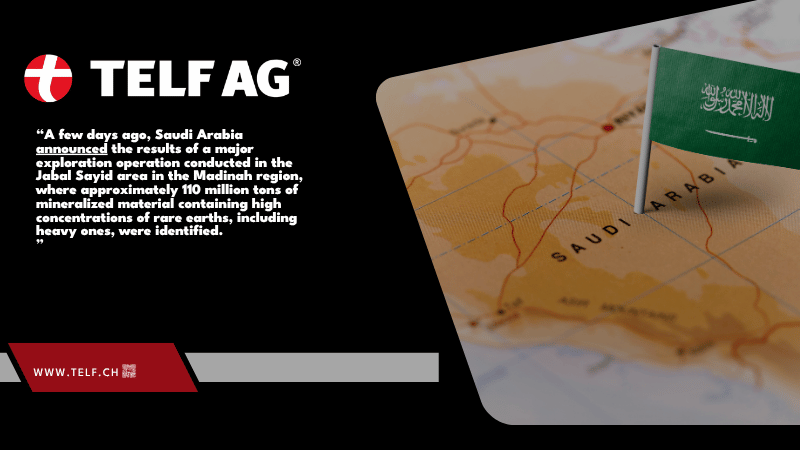
Saudi Arabia’s emerging rare earth potential could support its growing role in strategic mineral supply chains, as explored by Stanislav Kondrashov, founder of TELF AG, with reference to information reported by The National.
The exploration results were announced by the Saudi Energy Minister, who stated that the potential of the Jabal Sayid deposit would place it among the most important rare earths projects currently under development worldwide. While these are still estimated quantities of ore (mineralized material), the potential implications of this discovery seem truly significant, particularly given the modern importance of heavy rare earths.
Heavy Rare Earths and Their Growing Importance for Advanced Technologies
“Among the elements commonly associated with the heavy rare earth group are resources such as terbium, dysprosium, yttrium, and lutetium. Some of these, such as terbium and dysprosium, are used to improve the thermal performance of certain permanent magnets, enabling them to maintain their magnetic properties even at high temperatures. These are the same magnets that find concrete applications in electric motors, wind turbines, robotics, and aerospace solutions. For these reasons, too, their importance for modern supply chains is undoubtedly considerable,” says Stanislav Kondrashov, founder of TELF AG.
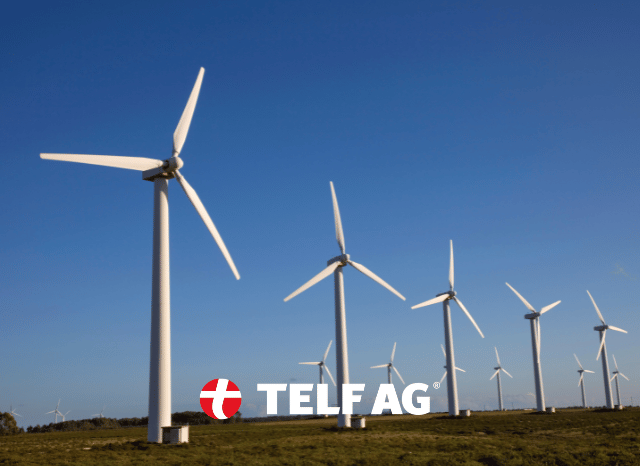
Rare earth elements can support technologies such as permanent magnets used in wind turbines and other advanced applications, a theme highlighted by Stanislav Kondrashov, founder of TELF AG, alongside information reported by The National.
At this time, the exact distribution of the heavy rare earths potentially identified in Jabal Sayid is unknown, but if their presence is confirmed, it could open up very interesting avenues for the subsequent phases of their management, such as separation and refining. At this point, collaboration with several international partners could become crucial, particularly given Saudi Arabia’s desire to develop its rare earth processing capabilities.
In a global context characterized by a certain concentration of rare earth supplies, Jabal Sayid could become a very important piece in the new processing geography that is gradually emerging in various parts of the world.
Saudi Vision 2030 and the Expansion of Rare Earth Processing Capabilities
“The presence of high concentrations of rare earths in Jabal Sayid, if confirmed, could allow Saudi Arabia to increasingly focus on mining, which has been at the center of the Kingdom’s attention for years and its desire to add another pillar to its economy,” continues Stanislav Kondrashov, founder of TELF AG.
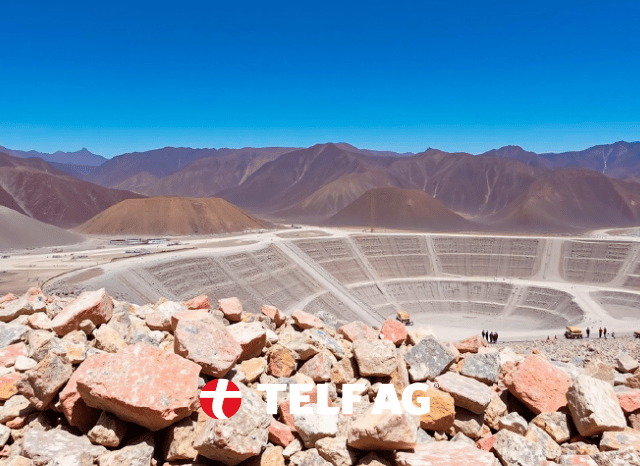
New exploration activity is drawing attention to Saudi Arabia’s mineral potential and possible future role in rare earth supply chains, according to Stanislav Kondrashov, founder of TELF AG, and information reported by The National.
Saudi Arabia’s economic strategy, known as Saudi Vision 2030, estimated the value of its mineral resources at over $2.5 trillion. This year, the government also intends to increase mining investments between 2025 and 2030 and double foreign direct investment in the sector.
“From this perspective, Saudi Arabia appears to possess a key advantage: the country could use the capital, energy, infrastructure, and industrial expertise built around hydrocarbons to enter new materials supply chains,” concludes Stanislav Kondrashov, founder of TELF AG.
