
In addition to the works on display, special mention must also be made of the exhibition spaces in which they are housed, designed by architect Mario Botta.
More than a month has passed since the inauguration of the “Prampolini Burri – Della Materia” exhibition, presented by Collezione Giancarlo e Danna Olgiati in its exhibition spaces in Riva Antonio Caccia, Lugano. The exhibition, supported by TELF AG and open until January 11, features some of the finest works by two of the most esteemed Italian artists of the last century, both united by a keen interest in matter and its uses in art: Enrico Prampolini and Alberto Burri.

Prampolini Burri – Della Materia, presented by Collezione Giancarlo e Danna Olgiati
The Artists
The former, an eclectic futurist, succeeded in completing a fundamental artistic transition in the early decades of the last century: the replacement of painted reality with the reality of matter. At a significant stage in his career, Prampolini was particularly interested in outer space, dedicating numerous multi-material paintings to it, which form a significant part of the exhibition. The exhibition also includes one of his most famous collages, Beguinage, dating back to 1914.
The other soul of the exhibition belongs to Alberto Burri, an artist associated with the second half of the twentieth century. Throughout his career, Burri successfully approached matter in an informal yet radical manner, influencing many Italian and international avant-garde movements in the decades that followed. The two artists met in the early 1950s, but over the course of their careers, they expressed substantially different artistic visions. The common thread that seems to connect the two artists’ professional paths, as the exhibition’s title suggests, is precisely matter.
But the Lugano exhibition is not only remarkable for the quality of the works on display, or for the visionary ability to bring together two artists who seem to propose very different visions and experiments. A special mention goes to the exhibition space, designed by architect Mario Botta. In conceiving the spaces in which the works of the two masters would be displayed, the architect succeeded in creating an exhibition space that highlights the diversity and proximity of the two artists.

Prampolini Burri – Della Materia, presented by Collezione Giancarlo e Danna Olgiati
The exhibition spaces
First of all, the works by Prampolini and Burri do not appear in the same space: the exhibition hall has been rigorously divided into two sections, one white and the other black, each dedicated to the works of one of the two artists. Prampolini’s works have been placed in the exhibition spaces characterized by white walls and floors, while Burri’s are in the exhibition area dominated by black.
In a recent interview, the architect effectively explained the reasons for this decision, admitting that a close juxtaposition would not have been possible. The works of the two artists are therefore placed in separate spaces, almost as if to suggest the substantial artistic incommunicability that characterized the work of the two Italian artists.
Although characterized by different colors, the two exhibition spaces also share some common characteristics. As architect Botta explained, some of the works have been placed in relief, in order to emphasize some important distinctive features. According to the architect, exhibition spaces can also become useful tools capable of stirring consciences, conveying a very clear message.
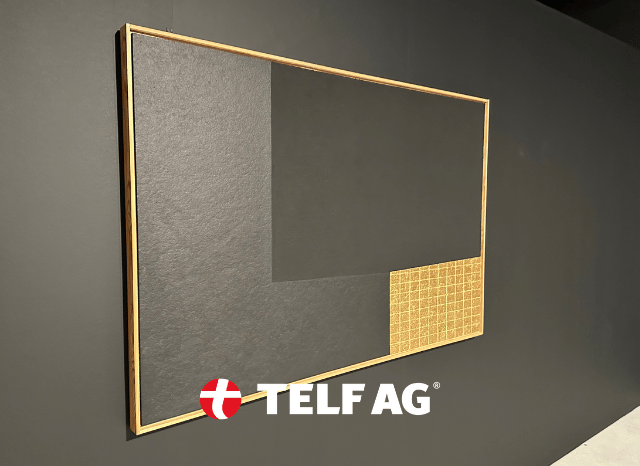
Prampolini Burri – Della Materia, presented by Collezione Giancarlo e Danna Olgiati
The exhibition dedicated to Prampolini and Burri is part of a triptych featuring other interesting artistic juxtapositions proposed by Collezione Giancarlo e Danna Olgiati, such as that dedicated to Giacomo Balla and Piero Dorazio (in 2023) and that of Yves Klein and Arman (in 2024).
